COMBUSTION RESEARCH
MILD COMBUSTION OF SYNGAS MILD: MODERATE TO INTENSE LOW-OXYGEN DILUTION
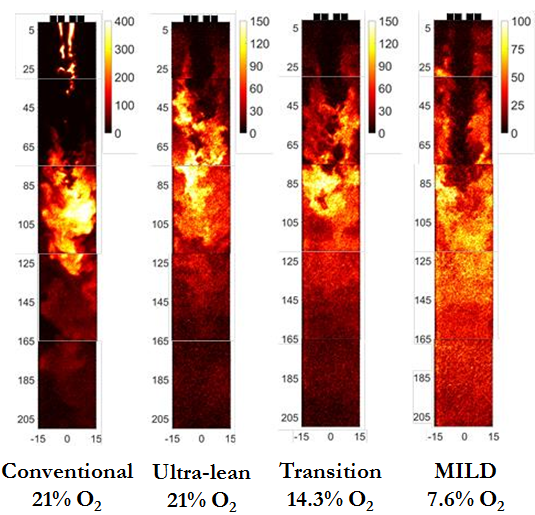
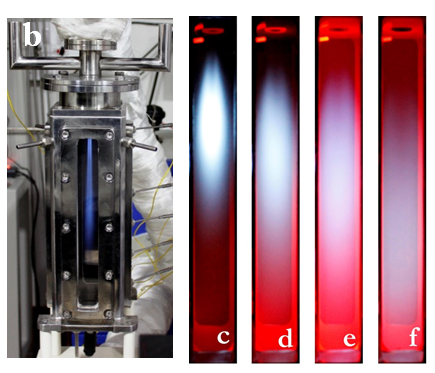
The present study concerns experimental and numerical investigation of the combustion of low-calorific value syngas in an optically accessible reverse flow combustion chamber. Several modes of operation are investigated to identify the best strategy for stable operation with low emissions of NOx and CO. The study investigates the combustion dynamics in the chamber and establishes the range of parameters for stable operation using OH* chemi-luminescence (5 kHz), noise (50 kHz), and exhaust emissions measurements (NOx and CO).
Next, the OH concentration and temperature are measured using PLIF and Rayleigh thermometry to provide a detailed understanding of the reaction zone structure. The instantaneous images show a complex reaction zone with thin structures near the inlet and progressive distribution of OH at the bottom.
The temperature measurements reveal a uniform thermal field throughout that can provide superior heat transfer characteristics in furnaces. The NOx emission is less than 1 ppm for all the cases, while the CO emission is highest for the MILD case (461 ppm) and lowest for the conventional case (32 ppm).
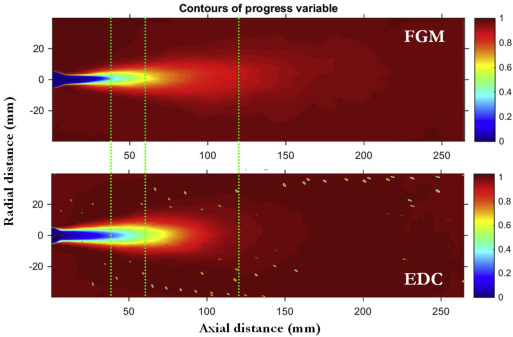
The experimentally generated data is next used to validate models that are subsequently used to numerically simulate scaled-up designs of the combustor with power ranging from 3.3 kW to 25 kW. Overall, the current investigation establishes that the combustion of low calorific value syngas can be performed in a reverse flow configuration with low emissions and potential for scaling to industrial sizes.
FIRE RESEARCH
Experimental investigation is conducted to study the effectiveness of chemical flame inhibitors in aqueous solution form along with the effect of droplet size distribution and flame chemistry on fire suppression effectiveness of pure water droplets. Interaction between chemical and thermal modes of fire suppression is also studied as part of the experimental investigation. The experimental work is complemented by numerical studies on behaviour of chemical fire suppressants (TMP, iron pentacarbonyl, etc.) in the presence of flow strain.

CATALYTIC COMBUSTION
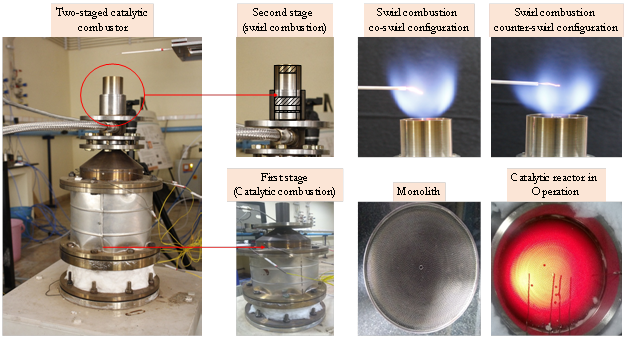
Among many unconventional strategies, catalytic combustion is promising in the field of power generation, pollutant abatement and micro-reactors. A two-staged combustor (first stage – catalytic combustion, second stage – conventional swirl combustion) which can be used as a hybrid heating source for solar-thermal power generation, was developed and experiments were conducted using syngas and methane as fuel.
Stable and pollution free (NOx < 10 ppm) combustion were achieved using syngas under fuel-rich conditions (equivalence ratio=4-5). Experiments were performed using methane under ultra-lean conditions (equivalence ratio = 0.2-0.4) and extremely low CO and NOx (CO < 10 ppm, NOx < 5 ppm) were measured at the exit of the combustor. Stable operations with near zero emissions confirm that this particular combustor is suited for power generation.
TRAPPED VORTEX COMBUSTORS (TVC)
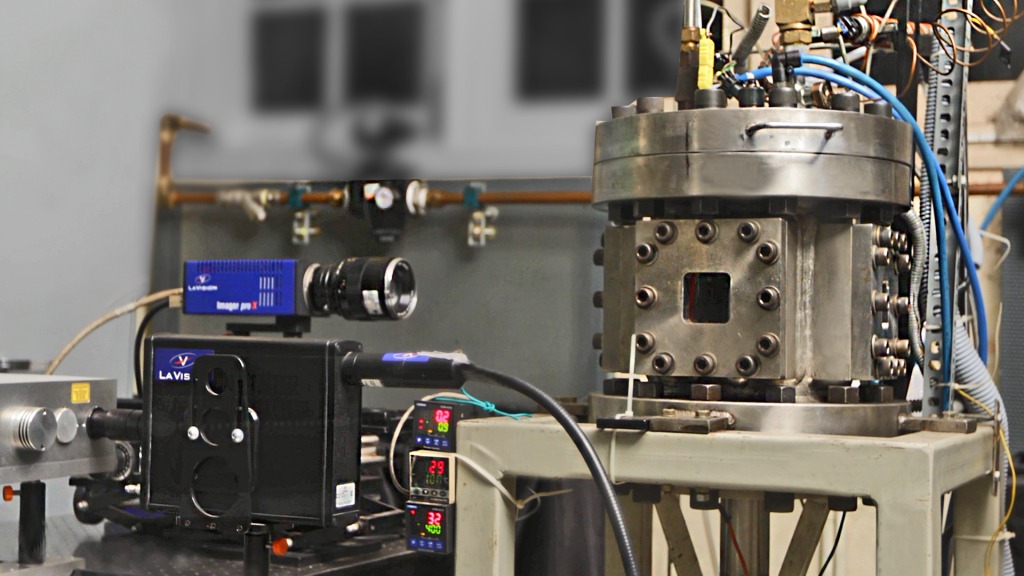
Trapped vortex combustion is being considered as a potential combustion technology for future propulsion and power generation systems. The combustor facility is designed to evaluate TVC capabilities such as wide stability range, low emission and high efficiency at high pressure. The facility is equipped with optical access and accurate controls of mass flow rate and pressure. The work focuses on the optimization of high-pressure TVCs using in-situ laser diagnostics (chemi-luminescence, OH-PLIF, PIV), high frequency pressure measurements, temperature measurements and emission measurements.
SOOT AND PARTICULATE REDUCTION IN HEAVY FUEL OIL (HFO) COMBUSTION
A research burner is designed to investigate the combustion of a dilute HFO spray. A novel LIF-based droplet imaging methodology is devised to image droplets in a controlled high temperature environment (800 – 1300 K) to determine the spray characteristics. A particle size spectroscopy technique generating particle number statistics is used to quantify effect of spray characteristics on particulate emissions. The following studies are carried out as part of this research work:
1. New research burner design and validation
2. HFO spray characterization using a novel LIF-based droplet imaging technique
3. Soot formation studies using the LII technique
4. Cenosphere formation studies using aerodynamic particle size spectroscopy